Are we heading for a Super El Niño in 2026? The oceans are running a fever, and the world could pay the price
A powerful Super El Niño could reshape global weather from 2026 to 2027, bringing extreme heatwaves, weak monsoons, floods, droughts, food inflation, and climate chaos across India and the world.
Shreya Sharon Kujur | New Delhi | May 24, 2026 6:32 am
Super El Niño in 2026?
Unless you are living under a rock, but on a rock that has been heating up rapidly, you must be aware of the El Niño phenomenon.
The recent flash floods in the US, and the heatwave crisis across northern India, with IMD issuing yellow alerts in several cities, all point to one thing- the Earth’s oceans are only getting warmer and El Niño is stronger than it has been in so many years.
Advertisement
This did not change overnight. Year after year, as global warming pushed temperatures higher, the oceans slowly developed a fever. Now, a catastrophe may be brewing. Brace yourselves, because the world could be on the verge of an extremely powerful El Niño this year.
Advertisement
What led to it? How will it impact India? And a roadmap for the future, let’s decode.
What does Super EL Nino mean?
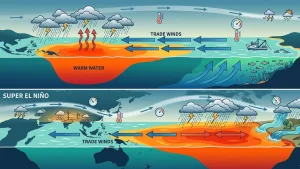
To understand a Super El Niño, you first need to understand El Niño itself. Every few years, the central and eastern Pacific Ocean warms above its normal temperature by at least 0.5°C. But when that warming crosses around an average of 2°C or more for a sustained period, scientists describe it as a “Super El Niño.”
This warming disrupts trade winds- the steady easterly winds that blow across the tropics and quietly keep the planet’s weather machine in balance. Once those winds weaken, heat begins piling up across the Pacific Ocean, and weather systems across the globe start behaving differently.
Some regions drown in floods. Others crack under drought. Heatwaves become harsher. Cyclones grow stronger. Temperatures climb.
And when the Pacific gets too warm, the whole world feels the fever.
This is not just a local phenomenon; it is a massive global disruption that simultaneously stresses the world’s food and water security as well.
From Mid-2026 to 2027: The El Niño threat timeline
The warning bells are getting louder. According to the National Oceanic and Atmospheric Administration’s Climate Prediction Center, El Niño is now highly likely to emerge between May and July 2026, with an 82% probability.
And it may not stop there. Scientists say the phenomenon is expected to continue through the Northern Hemisphere winter of 2026–27, with probabilities rising to a staggering 96% between December 2026 and February 2027.
What is even more alarming is that a “very strong” El Niño is now considered the most likely scenario during the October-to-February period.
The World Meteorological Organization has also warned that an El Niño event is expected to develop from mid-2026 onward, potentially disrupting global temperatures, rainfall patterns, monsoons and extreme weather systems across the planet.
How does Super El Niño affect India?
According to climate experts, India could witness one of the worst climate changes due to Super El Nino in 2026, especially during monsoons. The heat waves will be intense and weak rainfall resulting in water and crop shortage. Food prices are expected to grow higher if the Pacific Ocean continues heating up.
– Less rainfall: A typical monsoon period for India is between June to September, it provides almost 70% of the nation’s annual rainfall, and may be weaker than average this year. According to recent forecasts, India could only receive 92% of its total rainfall making 2026 a below average monsoon season.
– Agriculture under pressure: Since rainfall is directly proportional to growing crops, weak rains this year will automatically mean that crop production will reduce. Crops like rice, soybean and cotton will suffer affecting the livelihoods of those who heavily depend on farming of these crops.
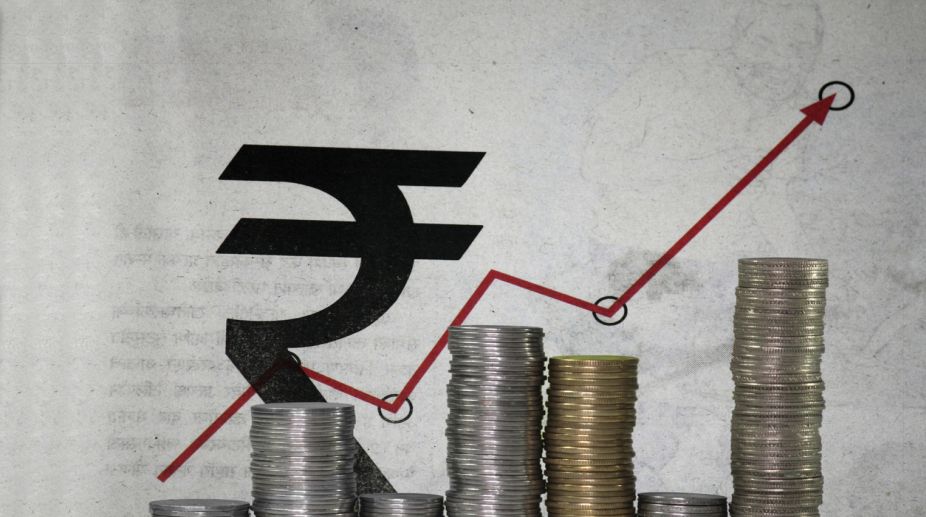
– Food inflation: Poor crop production this year will result in an increase in food prices. This will affect rural incomes, put pressure on the economy and even push the government to closely monitor or limit exports domestically.
– Water and power crisis: Summer this year will be more brutal as the country will experience lower water levels in its reservoirs due to extreme heat and poor rainfall. The signs are already visible, with many lakes in Delhi, Bengaluru and several other parts of the country drying up. This may result in water scarcity across many states and also reduce hydropower generation during peak summer months, when electricity demand is at its highest.
– Chronic Heatwaves Across the Nation: Scientists and health experts have warned about the intense heatwaves affecting 2026. With extreme temperatures and unusually warm nights, this year’s summer has become increasingly dangerous. People are being advised to stay indoors during peak afternoon hours and keep themselves hydrated at all times.
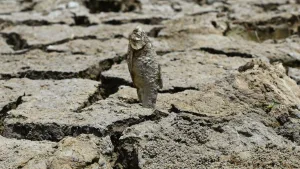
Cracked earth, dried puddles and hundreds of dead fish at Sanjay Jheel, Delhi’s Mayur Vihar amid intense summer heat (Image Credit: Anindya Chattopadhyay)
How does Super El Niño affect the world?
A massive surge of warm ocean water shifts eastward, disrupting global weather.
This massive phenomenon is not just India’s problem- it affects the whole world, Super El Nino will massively disrupt the weather patterns across the globe.
Record breaking high temperature: With the Pacific’s fever that is expected to increase over 2°C above normal, 2026 summers will have the hottest temperatures ever recorded.
Droughts: Water bodies will dry up completely especially in regions like Amazon Rainforest, Australia and regions across South East Asia will experience critical drought like conditions, threatening flora and fauna.
Floods: As already witnessed, parts of the US, Peru and Southwest regions could see intense rainfall. This may lead to flash floods.
Intense climate chaos: While some places may dry out, others may drown in excess water. And it doesn’t end there, the world will witness stronger cyclones to deadly wildfires and disrupted and unpredictable rainfall patterns.
Super El Niño carries a chaos that threatens to shake up climate conditions of not just one country or continent but the entire world. When our oceans boil the entire ecosystem changes. The ripple effect does not just stay in the ocean, it travels across continents to disrupt economies, wildlife, and lives of millions of people like you and me.
Maharashtra has invoked MCOCA against organised cattle smuggling networks for the first time, with Devendra Fadnavis also outlining the state’s El Nino preparedness plan.
The date for the onset of monsoon in Kerala remains the same and will arrive on June 1. The date for Chennai will be June 4, Panjim June 7, Hyderabad June 8, Pune June 10 and Mumbai June 11.